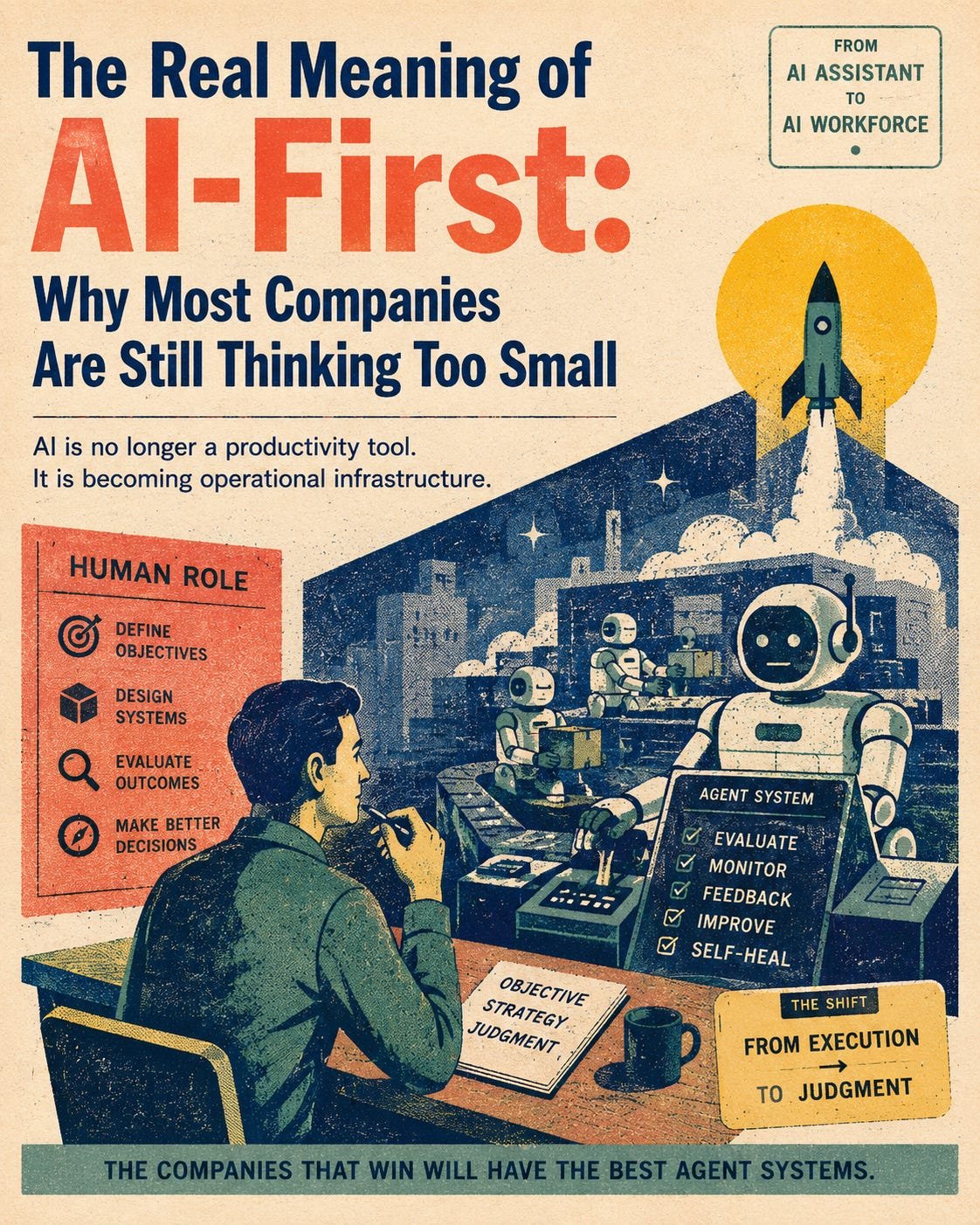
Over the past year, “AI-First” has become one of the most overused terms in technology.
Many companies claim to be AI-first simply because employees use ChatGPT, GitHub Copilot, or AI-powered productivity tools. But using AI and becoming AI-first are not the same thing.
The next generation of organizations will not merely use AI to assist humans. They will redesign their operations so AI agents become the primary execution layer of the business.
This shift introduces a new discipline often described as Harness Engineering.
Unlike prompt engineering, which focuses on giving instructions to a model, Harness Engineering focuses on building systems around AI:
Evaluation loops
Feedback mechanisms
Monitoring
Guardrails
Self-healing workflows
Autonomous execution
The goal is not to create perfect AI.
The goal is to create systems that can continuously detect, correct, and improve AI behavior.
In an AI-First organization, humans increasingly move from execution to judgment.
Instead of writing every line of code, humans define objectives.
Instead of manually completing every task, humans design systems that can execute tasks repeatedly.
Instead of performing work, humans evaluate outcomes.
This creates a fundamental trust shift.
Historically, organizations were built around trusting people.
Tomorrow’s organizations will be built around trusting AI systems — supported by verification, monitoring, and evaluation.
The companies that win in the next decade will not necessarily have the most employees.
They will have the best agent systems.
AI is no longer a productivity tool.
It is becoming operational infrastructure.
Originally published on MadebyVK on Substack.